
Day 8 // Great Expectations
July 28, 2026
Words by Jake Thorpe
Photos by Tom Gibbs, Tomás Montes, Sam Dugon, and Weronika Szalas
A Bucolic Bosnian Scene
Control Point 3 sits atop Bosnia’s Mount Trebević, overlooking the country’s capital, Sarajevo. The control itself is tucked away behind a wood-pannelled restaurant, Trebevićki Raj – purveyor of hearty food, good beer, and ferocious Bosnian coffee. As the evening light drained from the sky yesterday, its proprietor, Stefan Kcvoro, kicked a ball about with some friends, stopping, occasionally, to bring out a laden tray of Jelen Pivos – a Serbian beer with a strong export market. At this point of the race, with fatigue mounting and comfort a distant memory, CP3 should come as some very welcome respite.

As dawn broke over the dense forests of Trebević’s neighbouring peaks, Nicolas Chatelet (126) hauled himself around the last sharp hairpin of the parcours to secure the control point’s second stamp. The Frenchman looked fresh. Having extended himself the previous evening to edge a strategic lead over his fellow chasers, some rest had been high on the agenda.
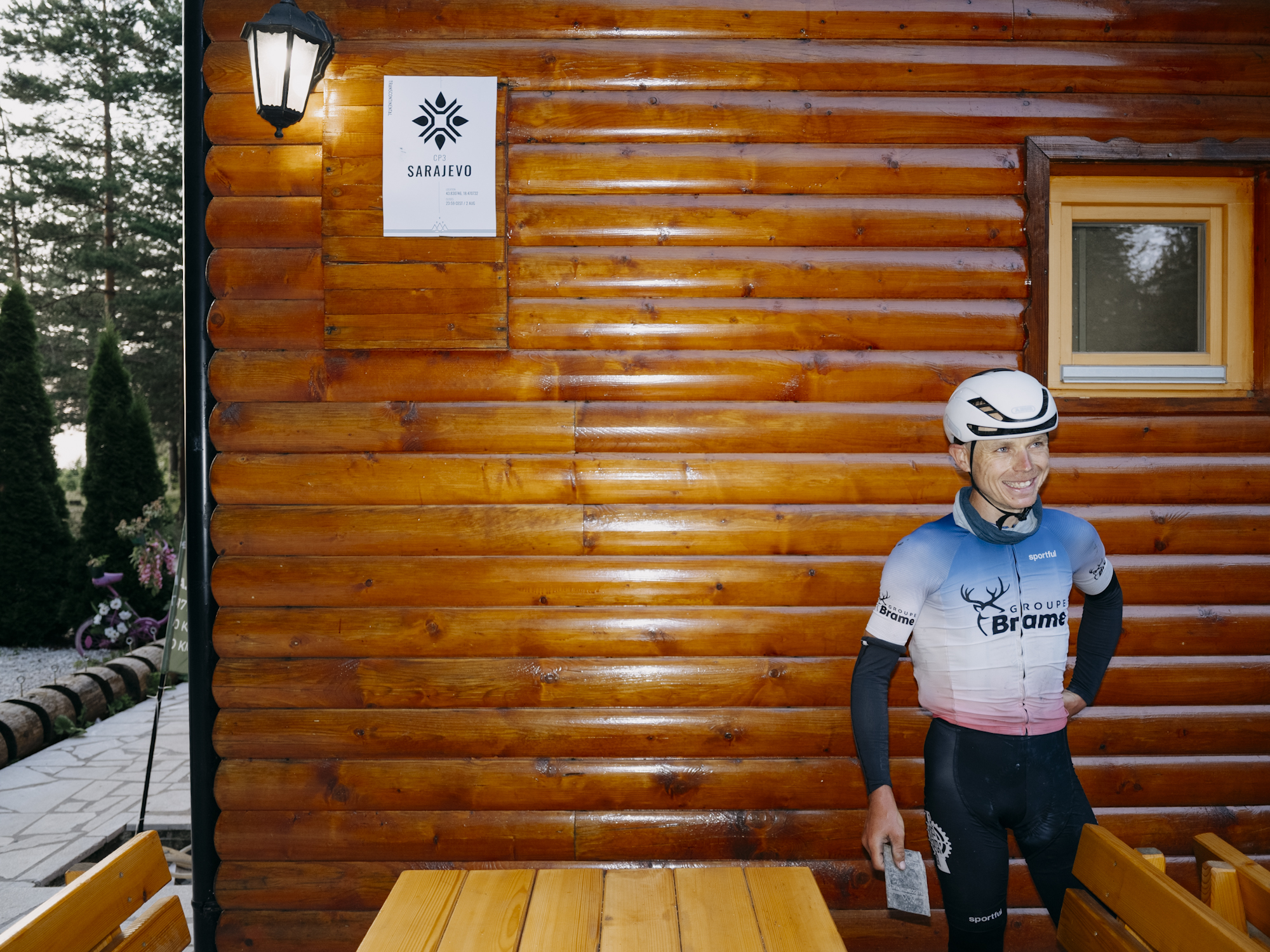
Up at Trebevićki Raj the night before, we had spotted his dot approaching the parcours, several hours after Robin Gemperle (001) had passed through, and wondered whether Nicolas might be pressing on to the control that evening. Having taken an exhaustive tour of Sarajevo’s fast food joints, however, he was soon ensconced at a hotel, tucked up for the night, preparing to tackle the parcours at sunrise. “I had many problems trying to eat in Sarajevo,” Nicolas explained when he arrived. “They wouldn’t take a card, or they would take too much time – one hour for a pizza.” At this point of the race, that didn’t feel a particularly productive use of time. Clearly Sarajevo struggled to put the fast in fast food.
Discussing his strategy, and whether he had designs on the race lead, Nicolas shrugged; “If Robin’s not good, why not? But I think he’s too strong, he’s a long way ahead. It’s not the main objective here.”
Steady Eddy
The main object lay a little closer: another Swiss rider, sleeping across the valley, just 3 km away. Jonas Verest (368) had, contrary to popular opinion, been content on the flatter Hungarian and Croatian plains. “I’m not much of a climber,” he conceded, “It was long roads, no turns for 40 km, very monotone views, but it was at least quite fast.” They had clearly suited him. Clocking in to CP3 at 08:04CEST, almost 90 minutes ahead of the next rider, Jos Koop (063), Jonas had held his position, third on the road since the second control.

For his part, Jos seemed relaxed as he rolled into the CP at 10:29CEST. He had clearly enjoyed carving down the banked concrete curves of the olympic bobsleigh track; “I want to go again!” had been his immediate response. I was almost convinced he might. Jos appeared to be keeping the blinkers firmly on his race. Uninterested in the tracker, his own position in the field, or any attempts to form a dynamic strategy, he remained focussed on his own plans, his own rhythm, and, crucially, his own enjoyment. A firm believer in concentrating on inputs, rather than outputs, Jos will continue to plug away, putting in time in the saddle, and staying well rested; the fruits of this effort, he believes, will only clarify in Kalamata.
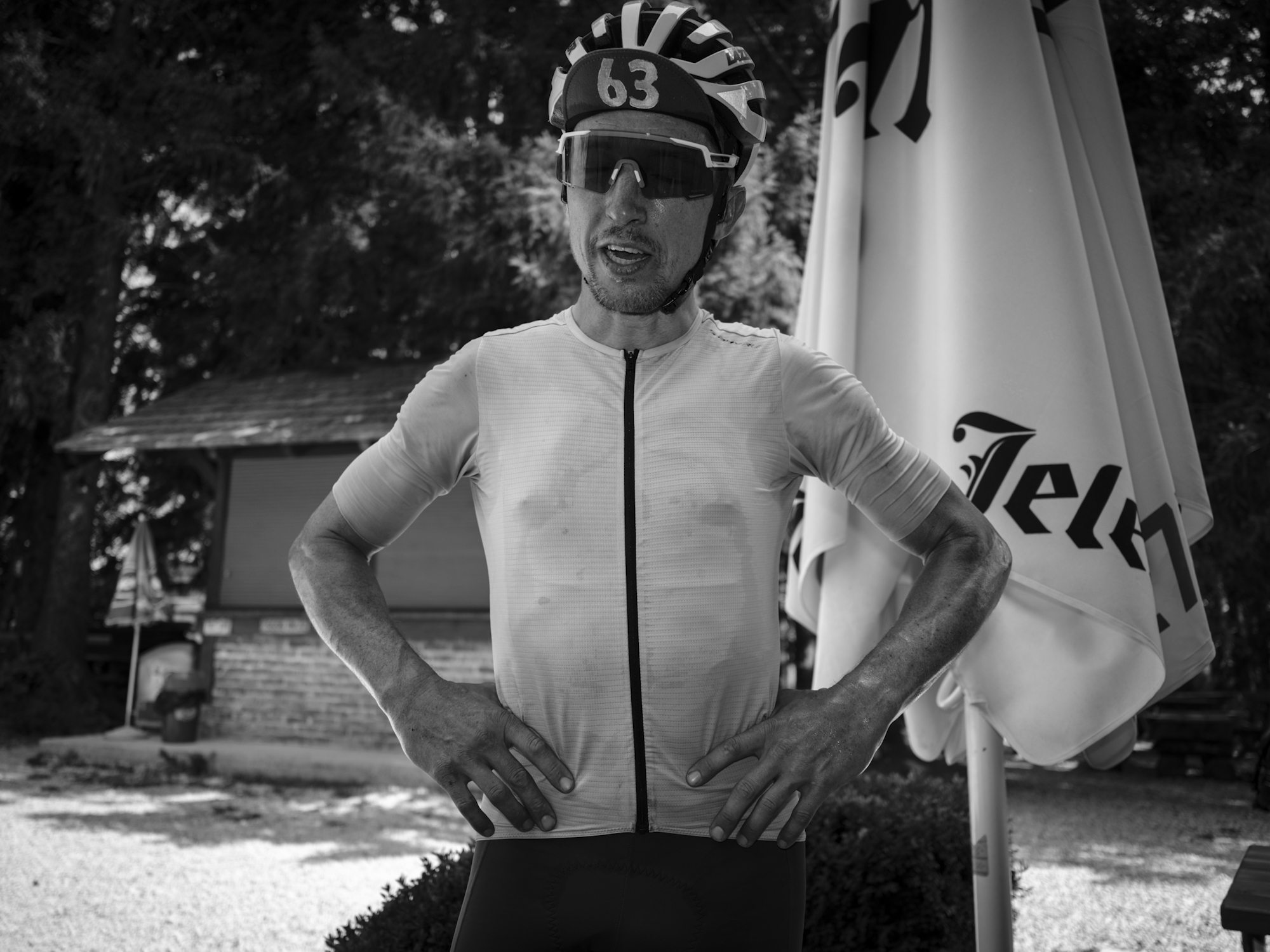
It’s fitting, then, that in recent days, Jos has acquired a new nickname. “They also call me Ed,” he volunteered, when asked for his name and cap number at the control. “If I take a video of myself, then my cap number, 63, reads backwards.”
Nicknames, however, are quick to evolve, and Race Reports are the perfect platform to help innovations propagate. So, Steady Eddy it is, in light of his level-headedness and measured pacing. Long may it last.
Cool, Calm and Collected
Another rider famed for his equanimity is Christian Dupraz (424b), riding again this year as a pair with his partner Dina Byland (424a). Tackling long, gruelling days in the saddle, crossing mountains in full winter conditions, and repairing major mechanicals on the roadside, all with the temperament of someone solving the Sunday sudoku, Christian is perhaps the perfect candidate to deal with the logistical quagmire of replacing a broken fork of an outdated standard in rural Slovakia.

The terrain of Parcours 2b had been too much for Christian’s classic steel touring bike, which duly cracked under the pressure, triggering a sequence of administrative hurdles for the 2nd position pair to overcome. Planning, first, to walk the 15 km to Liptovský Michal in the hope of sourcing another, Christian was forced to reconsider when a 1” fork seemed to prove elusive – not just in Liptovský, but in Slovakia as a whole. Seeking more creative solutions, Christian managed to track down a potentially suitable fork in Vienna, 300 km away. Given the store appeared unable to ship the part, however, Christian intended to catch public transport to the Austrian capital, and then ride back, to continue making forward progress with Dina.

The rules for Christian and his travel were clear: all forward progress must be human powered – if he travelled to Vienna, he would have to ride back; and private chartered transport is prohibited, so he would have to take public transport. The question around the nuance of these rules for a pair, however, remained. Would both have to travel to Vienna, or, in the spirit of a redistribution of kit, could Christian go alone, leaving Dina with the bulk of his baggage, in order to expedite his return ride? In the pursuit of forward progress, the spirit of pairs riding states that, as much as possible, pairs should function as a single unit. Yet in this case, given that, as a pair, they wouldn’t be making forward progress again until they were reunited, it was decided that Christian could make the journey solo, resuming their riding as a pair from Slovakia on his return.
Things, however, were quickly becoming more complex for Christian and Dina. With Christian having been refused entry by the bus services with his bike, the pair are currently working on a Plan C to allow them to continue within the General Classification. At this point, it’s unclear whether they’ll be able to; but, as we know, if anyone can find a solution, it will be them.
This is Spartan
Another of the race’s great problem solvers, Robert Müller (037) also saw his critical thinking tested today after discovering that his makeshift disc wheel – one of AEROBERT’s more striking modifications – had begun to rub on his rear brake, wearing down the breakpads and causing an unhelpful level of drag for the halfway point of a 5000 km bike ride. His solution? Creative destruction. Once again employing a rather rustic mechanical approach, he was spotted by the CP3 volunteers ripping off sections of the wheel’s plastic fairing with his bare hands. Curiously, Robert chose not to remove the wheel for this task; I can only assume there was method to his madness.

Noticeably less loquacious than in previous days, the mounting challenges of the race seemed to be talking their toll on Robert. Having spent a disturbed night trying to sleep outside – during which he was first drenched by the rain, and then robbed of all food by a dog – man, like machine, appeared to be coming apart a little at the seams. It’s not easy to sustain a race of such austerity, particularly at the sharp end. You often find the fastest riders making choices based on convenience rather than cost, but Robert races with the assistance of few, if any, comforts. It’s truly admirable. Explaining, back at CP1, how he had managed to ride his first Transcontinental on a budget of just €100, Robert embodies a racing spirit reminiscent of the TCR's rough-and-ready early years.
Deeper Devolution
At this point in the race, it’s not only bikes, but bodies that are beginning to take a beating. We’re seeing stories creeping in from across the field of the various ailments that tend to surface when you choose to spend a week welded to your saddle.
For Manu Rudaz (004), 6th through CP3, the discomfort has concentrated at the extremities, most notably in his toes. His attempts to revive any feeling in his big toes, which – in a move reminiscent of Darren’s devolved body parts in TCRNo4 – he has named Fred (right) and Joe (left), have attracted some attention on social media, prompting him to wonder whether they have the potential for a more lucrative career online going forward.

Anna Carlqvist (223), who, by evening, had entered Serbia on her way down to CP3, was struggling with a knee the size of a grapefruit, having been subjected to a relentless regime of revolutions in recent days. While Lea Hamberger (404), despite maintaining steady pressure on the leading FLINTA riders, Sarah Bosslet (120) and Camille Albisser (270), has developed a sore achilles – a niggle she’s been self-medicating with ice lollies stuffed down her socks.

For Omar di Felice (195), however, it wasn’t so much the cumulative kilometres causing issues, but the cumulative exposure that has come with them. With temperatures soaring as he hit Hungary, Omar found himself riding through the heat of the day under the blazing midday sun near Budapest. Severe heatstroke followed, the resulting fever forcing the experienced Italian ultra-cyclist to take some extended time out of the saddle – 20 hours in total across subsequent stops at two local hotels. Now back on the road, however, and making solid progress towards the Bosnian border, it seems Omar’s rest has been reviving.
A Bee in the Bonnet
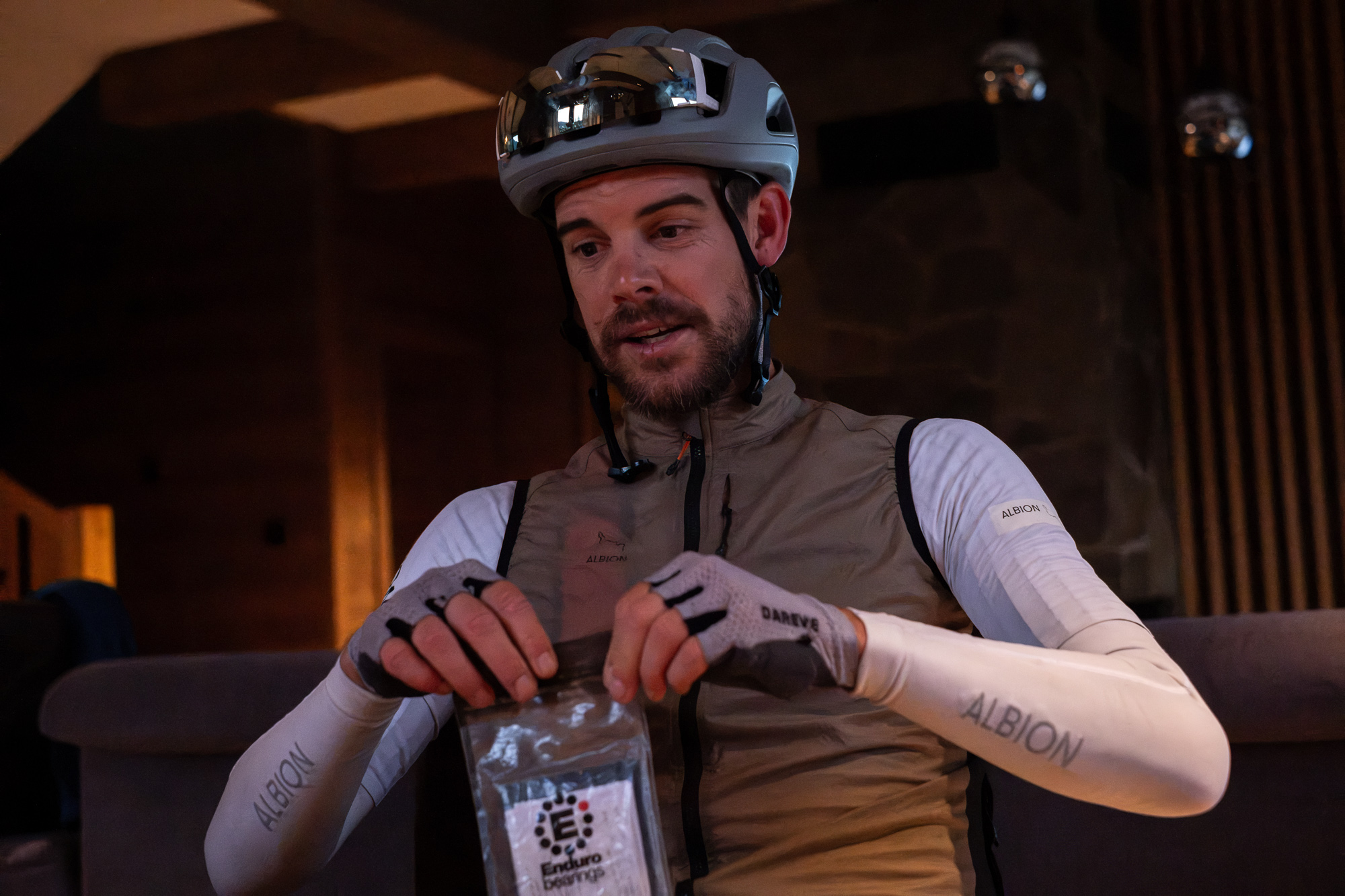
As Omar discovered, nature can be a cruel mistress. While for many, the sheer beauty of their surroundings is what carries them through the lower moments, for previous TCR winner, Josh Ibbett (101), the natural world dropped him squarely into one. Stung by a bee through his helmet back in Poland, Josh suffered a severe allergic reaction. Itching ensued, followed by hives and then nausea. The composition of his face changed dramatically.
Fortunately, Josh was prepared. Having experienced something very similar in Morocco earlier this year, he had antihistamine on hand as an emergency measure to tide him over until the hospital could administer a hefty injection of corticosteroids.
Josh was good enough to inform us of the specifics of his treatment. As a substance banned by the World Anti-Doping Agency in competitive sports, he was aware that the prohibition of the contents of his injection normally extends to the TCR. In Josh’s case, though, as a medical necessity, it would be quite a stretch to argue that it gave him any advantage. Having spent a day with a face like Marge Dursley – inflated to several times its usual size – can’t have aided his aerodynamics. And the 24-hour disadvantage of a hospital stay and the subsequent mandated rest won’t be too easy to make up, even as a well-juiced super cyclist. We were glad to reassure him that it had no impact on his standing in the GC.
The Balkan Boost
By his own admission, Josh’s race so far – the bee sting notwithstanding – had been “a bit up and down.” His preparation had been limited. Having only committed to racing the TCR in May, he’d allowed himself a rather narrow training window. And with his bike arriving less than a week before the start line, the first few thousand kilometres of the race had felt like a protracted bike fit, with tweaks to his position a frequent roadside occurrence. Beyond that, the Baltic had thrown his rhythm, with a daytime – rather than the planned nighttime – crossing disrupting his sleep schedule. But promise, for the TCR veteran, lay just over the horizon. “I can’t wait for the Balkans,” he said at CP2, “it’s why I’m carrying on really.”

This story was a common one. Polish rider Joanna Ruminska-Pietrzyk (148) admitted on Parcours 2a, “I could use every good excuse to stop now.” Suffering with saddle sores – another common ailment at this point of the race – aggravated by the specific movement of Czechia’s climbs, Joanna admitted that the Balkans were acting as a magnet, helping to push her on through the lower moments of more familiar territory. “They’re the reason, like always, that I signed up for the TCR.” Carrying such significance for riders, it’s no wonder that the Balkans have become the race’s heartland.

Great Expectations
As riders conclude their first week, with many approaching the halfway point of their continental traverse, motivations are becoming particularly crucial. With the adrenaline of the start having waned, and with the draw of the finish line a distant prospect, the liminal space remaining can be some of the race’s toughest.
This certainly seemed the case for our man on the road, Andrew Phillips (00a). Riding solo, following Jon Endres’ (00b) unfortunate scratch, the flat drag across Poland had proven deflating. As a pair, flat riding allows one of the core advantages to kick in: drafting. But the frustration of foiled plans, together with the blustery cross-headwinds, had gradually ground Andrew down.
.jpg)
Entering Czechia and the Jeseníky Mountains had provided a boost for Andrew yesterday. “It’s easily the biggest climb we’ve had since Norway,” Andrew shared, of Praděd. “It’s so much easier to remember why I’m here when I start going uphill.” However, back on flatter ground again today, Andrew was once again in the doldrums. “I’ve been really wondering what I’m doing it for. My body’s been hurting, I’ve been missing my partner, my family, my friends,” he admitted.
The why, for Andrew, is proving complex. As a natural racer, riding outside of the General Classification leaves him with a motivational gulf. “I’m pushing myself too hard to fully enjoy it, but not hard enough to really achieve anything,” he concluded. I’m sure it’s a sentiment some others out there in the mid-pack can relate to. “Maybe it does answer some of my why questions,” he continued. “I don’t have that raison d’être of the competition anymore, and I think I’m a bit lost without it.”
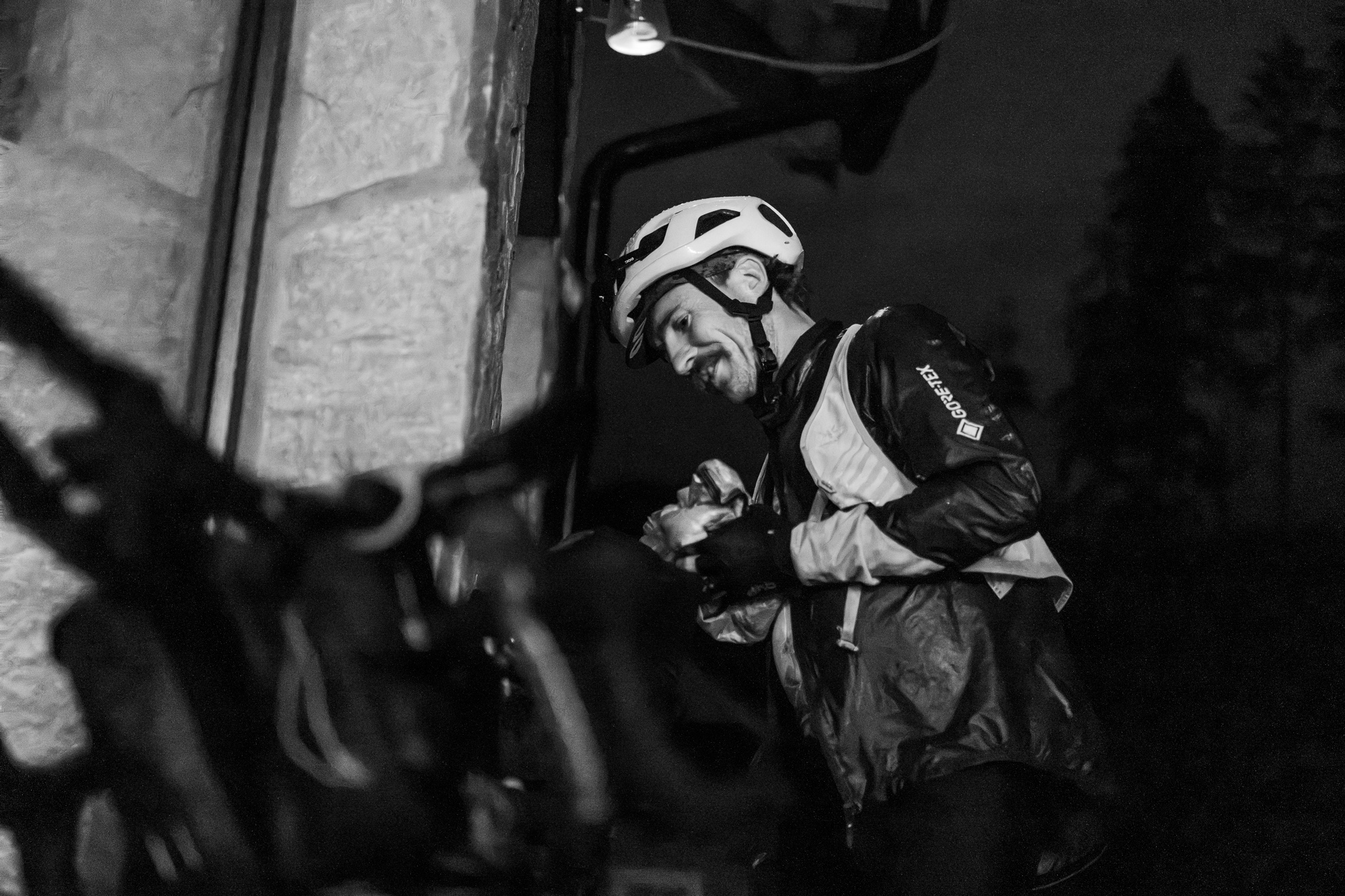
As we’ve seen elsewhere in the field, however, the competitive raison d’être can sometimes prove just as unconstructive, particularly when held up against your own expectations. Martin Moritz (002) has been feeling its destabilising swings: the emotional flux resulting from changes at the front end. Having ridden such a commanding race to take 2nd place last year, it can’t be easy playing catch up. Christoph Pernsteiner (011), too, 8th in last year’s standings, was also feeling expectation weigh heavy. “The second time is more challenging,” he admitted, “you know what you’re capable of.”
