Day 18 // Enjoyment: The Right Word?
August 7, 2026
Words by Jake Thorpe
Photos by Matt Grayson, Michael Drummond, and Tomás Montes
Suffering with Purpose
More than a handful of our riders’ one-line synopses, a tough ask after a 5,000 km continental odyssey, simply read: long. It’s difficult to disagree. This edition has continued the recent trend towards lengthier routes – not by design, but as the natural consequence of its start and finish locations, and the TCR tradition of crossing the continent, where possible, from sea to sea.
For riders like Josh Ibbett (101) and Matthew Falconer (253), veterans of the early races, this has been one of the defining changes of the modern TCR. For Joanna Ruminska-Pietrzyk (148), returning for a second year after her debut in TCRNo9, the added distance represented a disproportionate challenge. “I did three long races in the past, each around 4000 km,” she explained at the finish line, “and I didn’t realise how much of a difference those last 1000 km make. It’s such a huge burden on your body, and it grows exponentially.”
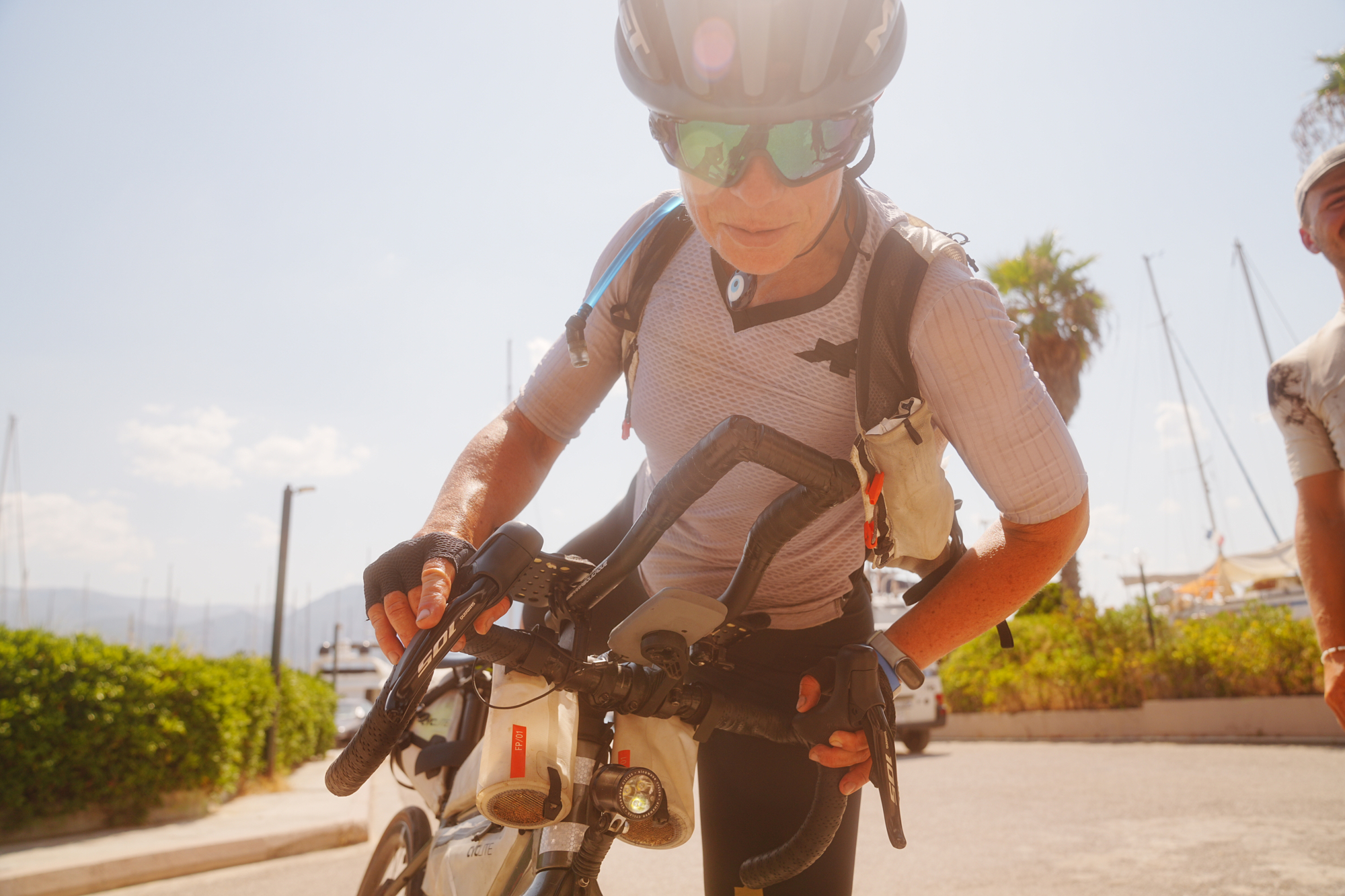
Earlier in the race, on the flat Polish plains she calls home, Joanna had joked that she was enjoying the variety of her riding-related ailments. “It’s a good idea to have a few sources of pain so you can shift your attention from one to the other,” she laughed. Joanna admits she was searching for the silver linings in a difficult ride while passing through more familiar territory. As she revealed, in hindsight: “Of course there are always ups and downs, but if you have a down in a place where it’s easy to scratch, then it’s very likely that you will.”
Now, with the race behind her, there was no need for such mental gymnastics. The time for rest had finally arrived. “It’s quite funny,” Joanna reflected on the lethargy that followed her finish, “you do a race, you cycle for 5000 km, and then it ends and your body says, ‘Ok, now I won’t do anything.’ I’m even struggling to walk!” Asked whether divvying up the discomfort was still helping, she laughed: “No, not any more. Right now I’m all pain.”
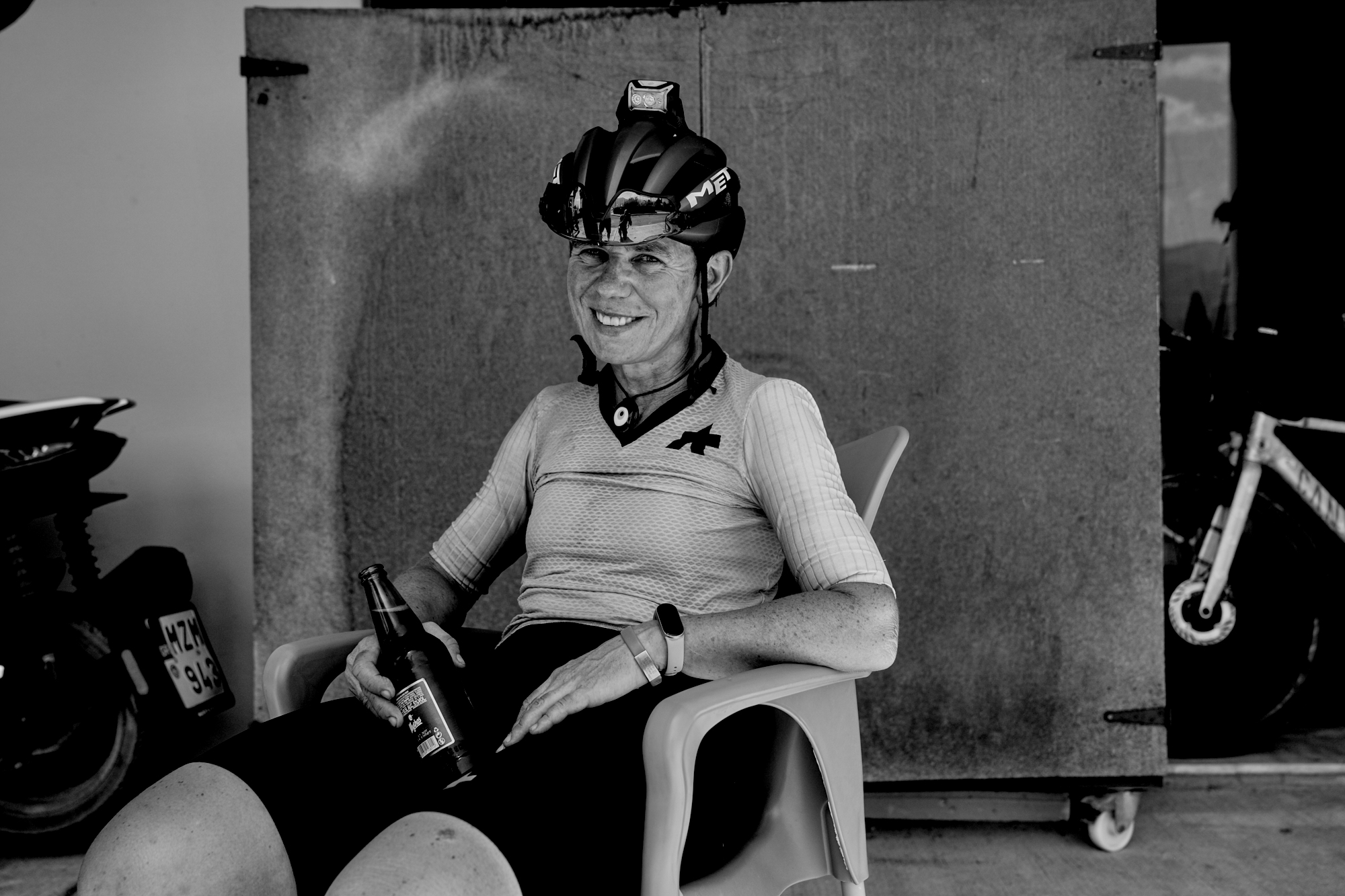
For Joanna, the discomfort was never a problem. In fact, it was a large part of what drew her to the race. But she was careful to distinguish between suffering with purpose, and suffering without. “If you suffer physically because what you’re doing is challenging, it’s alright; but if you suffer because you aren’t enjoying the race in one way or another, then it’s a different story. You must enjoy the race – enjoyment is probably not the right word – however you define it, you just need to feel like it’s something you want to do. And then it’s alright; you can suffer all you want.”
So where, for Joanna, did the enjoyment – or whatever you call it – lie? What had compelled her to race again? The answer, I suspect, is one shared by many of our riders. “I get this very significant feeling of empowerment, of self-confidence, that builds up throughout the race,” Joanna explained. “It tells me that I can cope with whatever comes my way. If there are mechanicals, I'll deal with them, if there are other problems, I'll deal with them. And this is something that also translates into normal life.”
Business Secrets of the Cyclists
However much the experience might eventually empower, it’s not easy to sign up to race across a continent. To take to the start line requires real bravery. From the outside, the confidence to do so can appear binary: some people can, some people can’t. “I could never do that,” is rarely far from the lips of those for whom our sport appears an audacious endeavour – only one shade short of insanity.
.JPG)
But as Grzegorz Oszast (162) recalled on the finish line of this, his second TCR, the process is never as spontaneous as it seems. “I remember someone told me, ‘Greg, there’s a race that’s 500 km long.’ I said, ‘Jesus Christ! 500 km? That’s not possible.’ But then the next year it was 1,300 km, two years later, 3,600 km, and then on the TCR last year, 5,150 km.” The incrementality of the journey towards a TCR start line can often be obscured by the focus on those who seem to have ridden such distances since before they could walk – perhaps even in utero. Greg’s advice? Treat riding an ultra like founding a company. “I would say that doing sport is like doing business. If you expect results, you have to put in a lot of work, be patient and be consistent.”
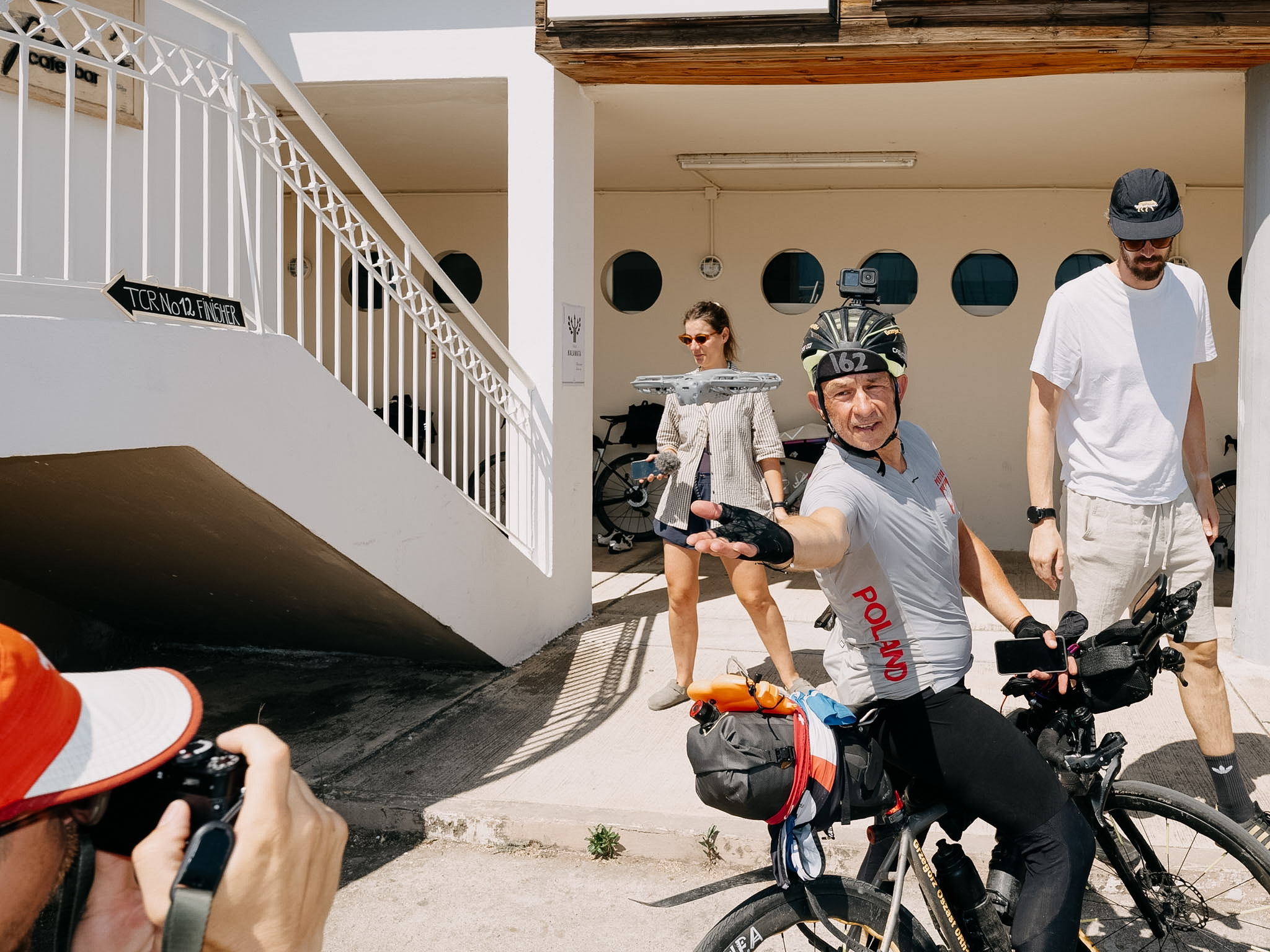
Like Mudit Kohli (128), who has been appreciating the race’s moments of stillness, Greg too had felt the call of the quiet. “I wanted to be alone,” he explained, “without excess information, without my phone, so that I had time and space to think about the important things.” Having nearly decapitated our finish line photographer, Mike Drummond, with his drone, however, it was clear that output, if not input, had been high on Greg’s agenda. Throughout the race he had been sharing videos from the road with his family – clips that, he hopes, might one day come together into a film of his journey. Running a small consulting company back in Warsaw, Greg aims to apply the lessons of the road in his life – and work – back home, and share stories from the road that will inspire more broadly.
Jekyll and Hyde
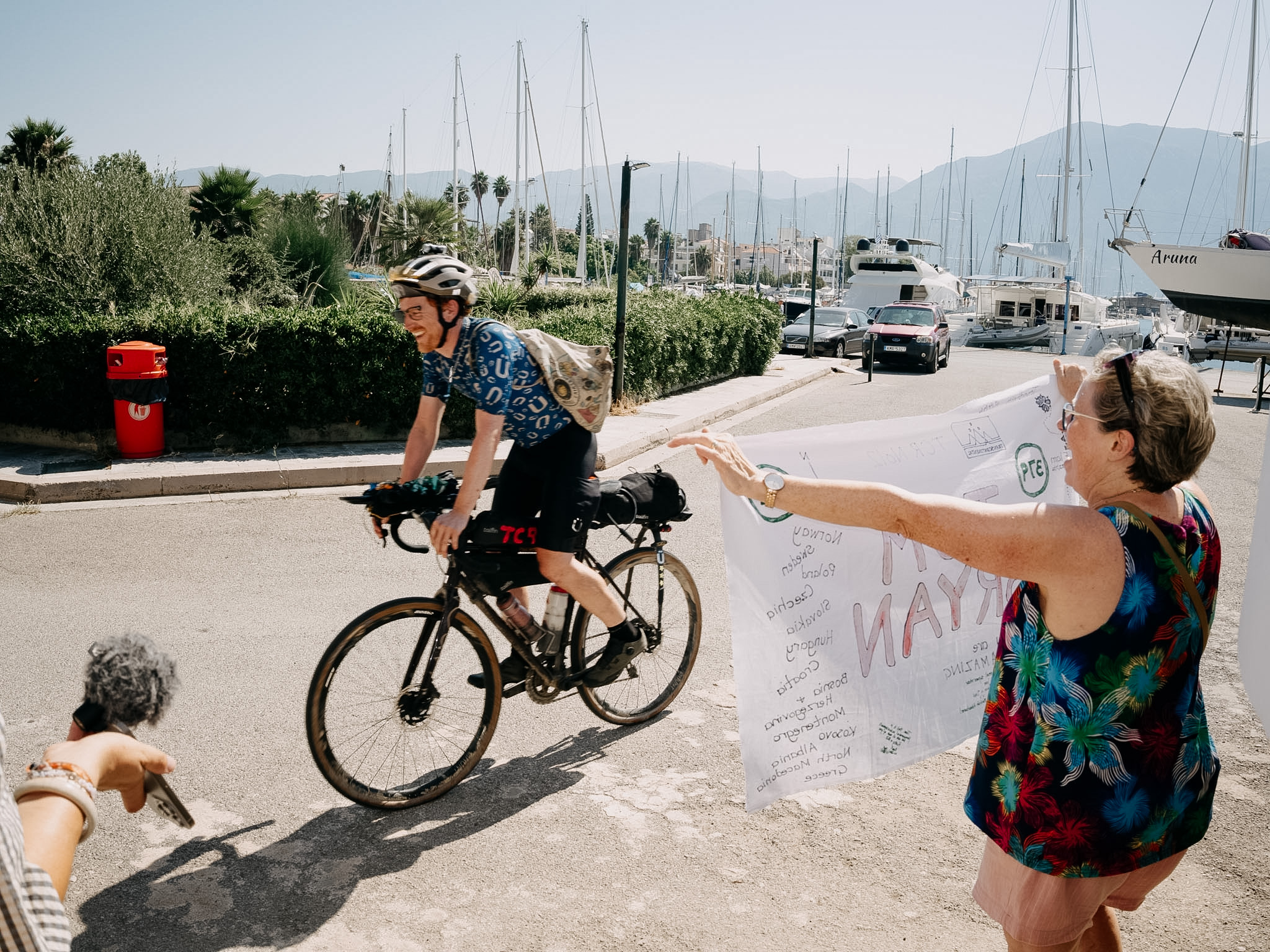
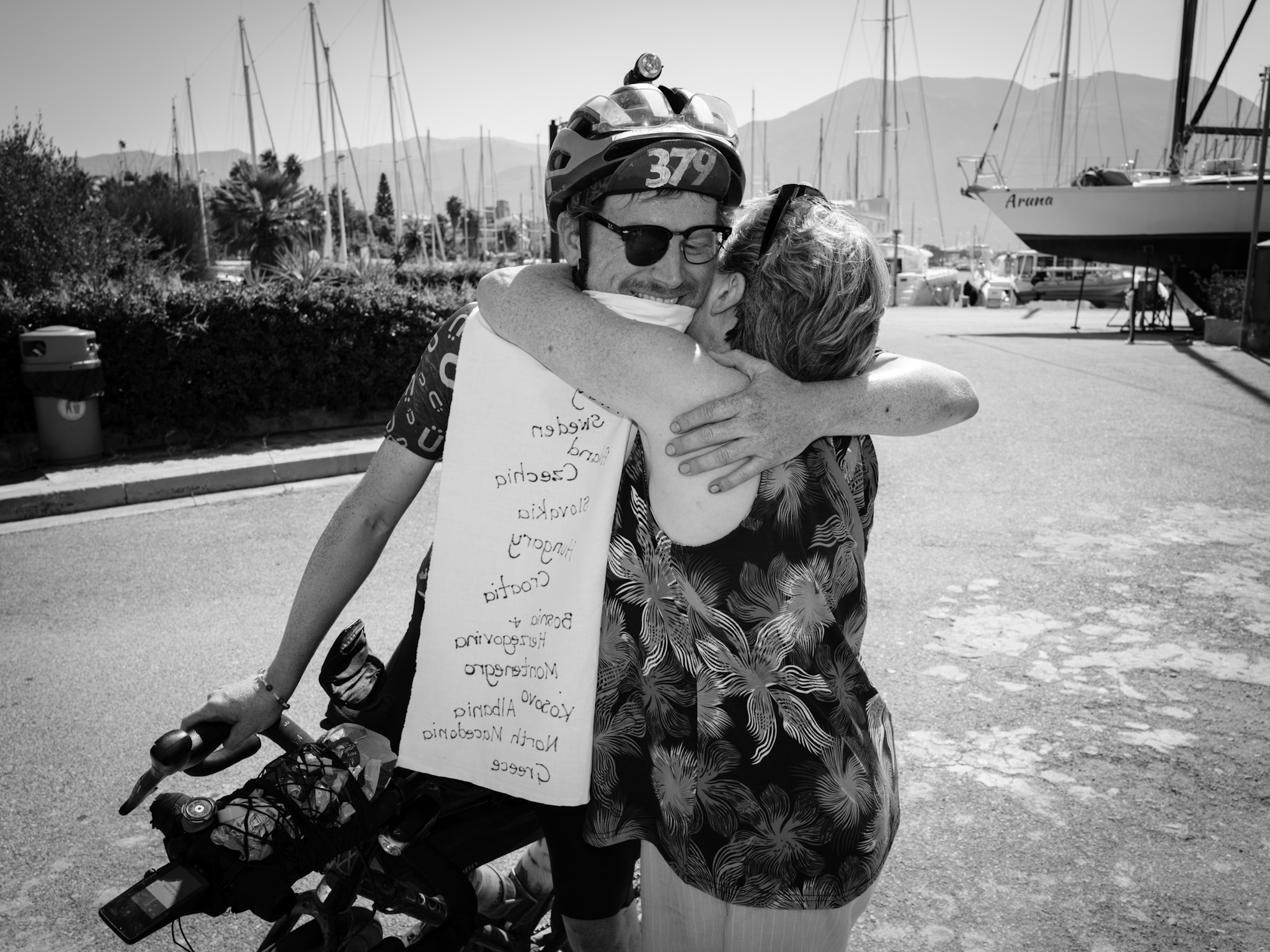
Swashbuckling through the streets of Kalamata, Tom Bryan (379) arrived this morning, sporting a single darkened lens in the Balkan-bought sunglasses that had replaced his own pair, lost earlier in the race. “This is a metaphor for the latter part of the race when everything starts to fall apart,” Tom chuckled as he arrived at Skipper’s Café to bring his first ultra to a close. Greeted by his mum, Tom was treated to more than the usual spoils of the finish line, with the standard stamp and the beer joined by a medal and a hand-drawn banner. “Proud?!” Karoline cried, “I don’t think proud even says it. It’s just so emotional.”
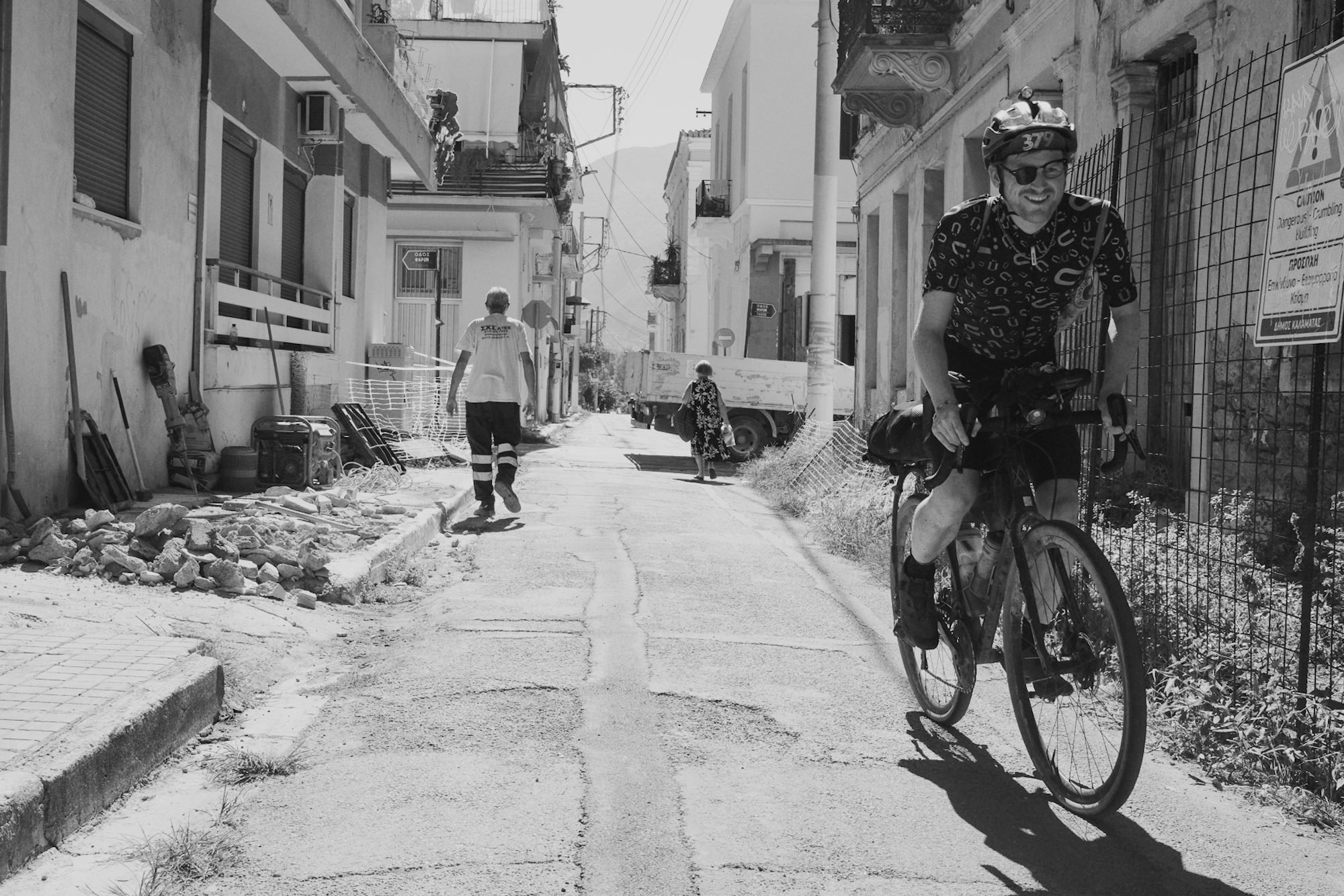
After a short hug with his mum – a longer one would come later, after a shower – Tom reflected for a while on his race. As an experienced tourer but a debut racer, he seemed to have drawn from two different instincts throughout the race: one familiar, one less so. “There are two types of Tom,” he began. “There’s Touring Tom and there’s Racing Tom, and both have turned up at different times.” For him, some of the beauty of the race had come from having both the option, and the need, to tap into each. “When you’re touring, it’s all about conserving energy for the next day. But I think I found a lot of confidence knowing I could push,” he acknowledged. Racing Tom, it seems, had proved useful.
Concluding his efforts with a 30-hour push to the finish, it’s no wonder Tom’s word of the race was relentless. “It was quite overwhelming knowing I’d be going into the third week,” he admitted. “The guys and girls still out there are the real troopers, they’re doing this for longer, and their bodies are being pushed for longer.” It’s a perspective shared by many of the race’s quickest riders. The TCR asks every rider to find their own edge – the difference is simply how long they are asked to remain there.
A Glutton for Punishment
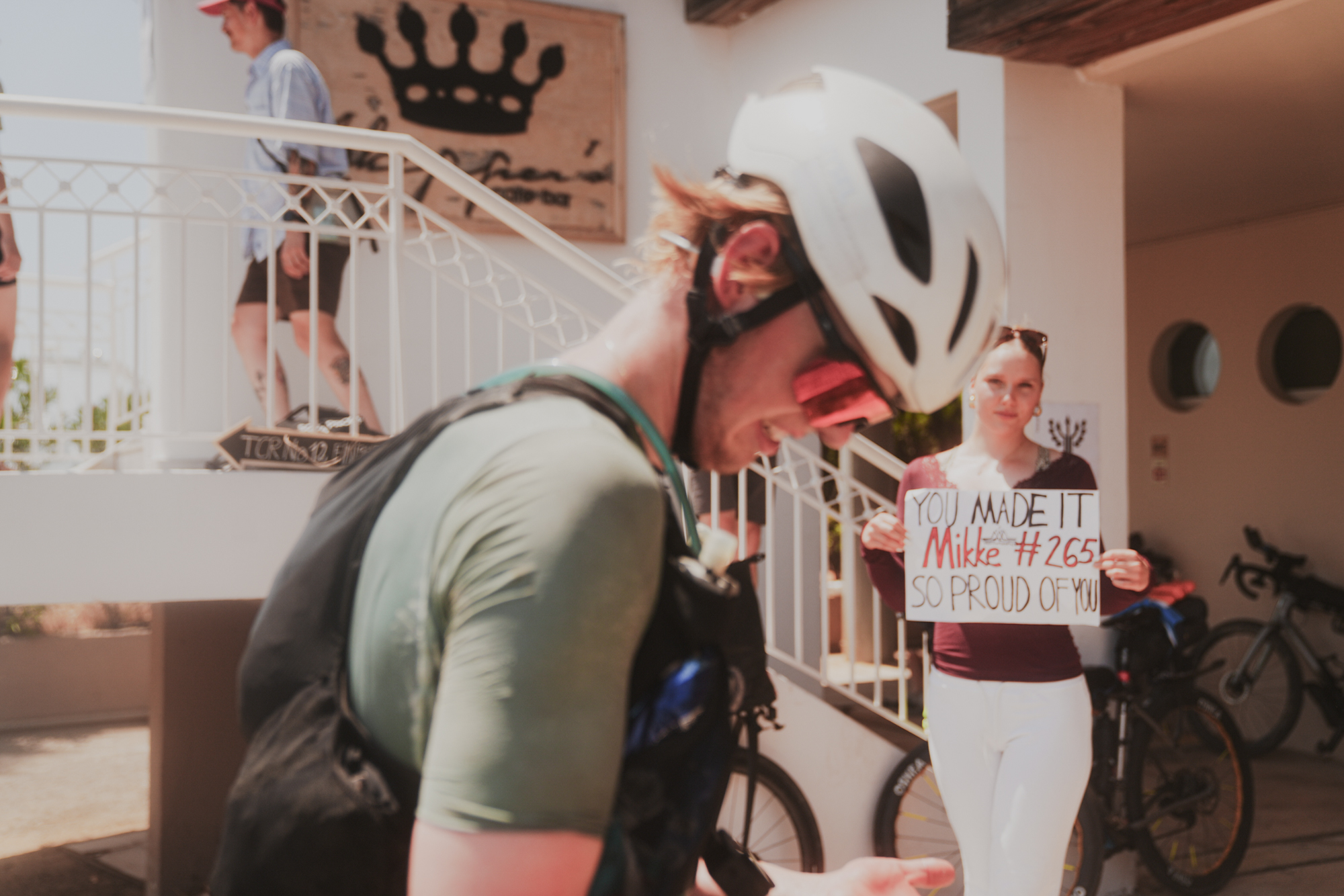
In the case of Mikke Luostarinen (265), however, the demands of his race were, at least in part, self-inflicted. Mikke had opted for an ultra-light set-up for his third consecutive TCR. So light, in fact, that it omitted a jacket for the sub-zero nordic nights – something that had made the opening bars of his race rather miserable. But things soon got a whole lot worse.
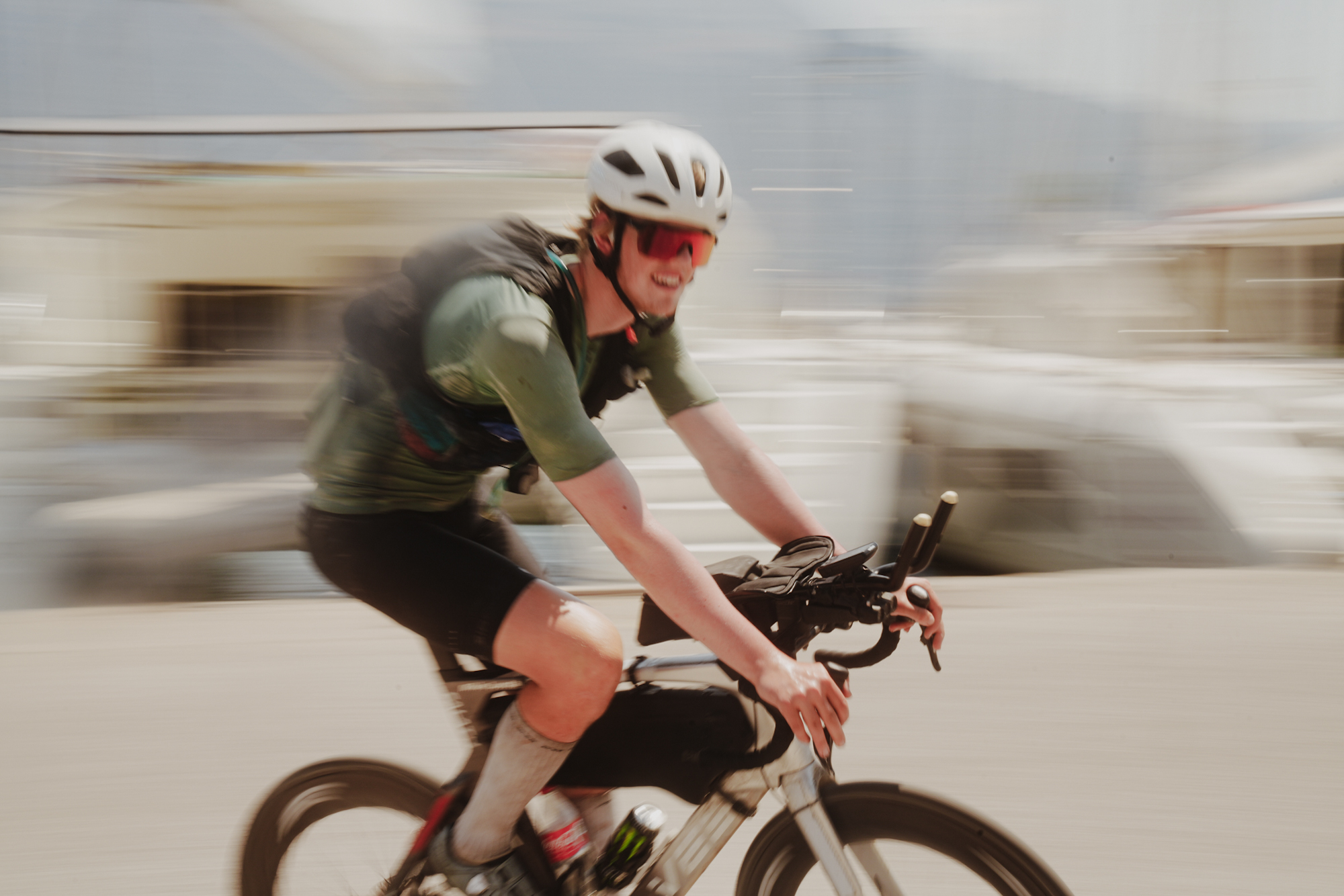
Just a day into the race, Mikke discovered that the charger for his electronic gears had broken, and, what’s more, having ridden to Trondheim from his home in Finland, they’d already run out of juice. Hoping, perhaps, to reduce the weight of his set-up further, having disposed of the broken charger, Mikke made the wild decision not to replace it, but instead to ride the remaining 4,000 km without gears. “Riding the TCR is almost a once in a lifetime experience,” explained the three-time veteran, “but riding the TCR single speed is definitely a once in a lifetime experience.”
Funnily enough, this isn’t the first time Mikke has found himself in this predicament. After being forced to race both TPRNo5 and the Three Peaks Bike Race without the use of functioning gears, you start to wonder whether he’d be better off lining up without them in the first place. Mikke insists that, if he could do it all again, he wouldn’t change a thing. Whether that’s an unwavering commitment to the spirit of self-reliance or simply proof that he’s a glutton for punishment is still very much up for debate.