#TCRNo13
Blown back and forth along Atlantic coasts, first west, then north, until at last the squall passes and, like a ship returning to an even keel, we find our centre once more, in the Transcontinental's homeport: Geraardsbergen.
But as ocean currents change and collapse, the race must change too, and, as if addicted to the midnight sun, we start on the eve of the hemisphere's longest day.
Twilight and evening bell, and after that the dark!
As the sun finally begins to sink, the crowds throng the Muur, and the belleman knells from beneath his tricorn hat, the 13th edition of the race will begin its annual Transcontinental crossing.
And as the flood bears them far, bonded in isolation and united in exploration, they sail the era's fresh tradewinds. The wise amongst them will know, on this 13th edition, that the race's very spirit is their most precious cargo. Wiser still, and they will understand that carried properly, cargo and ballast are one. No profit without stability, no success without integrity.
Provisional race details
Registration and briefing: Sunday 20th June 2027, 10:00–16:00 CEST (briefing 17:00)
Race start: Sunday 20th June 2027, 22:00 CEST
Finish party: Wednesday 7th July 2027
General Classification cut-off: 23:59 CEST Wednesday 7th July
Applications: now open – close 23:59 CET Thursday 31st December 2026
Open to: solo entrants or pairs
Cost: £580 per rider (£30 application fee, £315 deposit, £235 balance) + refundable £130 tracker deposit
Stay tuned
Receive regular updates about our races, offers and more
About the Race
The Transcontinental Race is the definitive self-supported bicycle race across Europe. At the sharp end it is a beautifully hard bicycle race, simple in design but complex in execution. Factors of self reliance, logistics, navigation and judgement burden racers’ minds as well as their physiques. The strongest excel and redefine what we think possible, while many experienced riders target only a finish.
The Transcontinental is a single stage race in which the clock never stops. Riders plan, research and navigate their own course and choose when and where to rest. They will take only what they can carry and consume only what they can find. Four mandatory control points guide their route and ensure a healthy amount of climbing to reach some of cycling’s most beautiful and historic monuments. Each year our riders cover around 4000 km to reach the finish line.


Mike Hall
The man who started it all. Mike Hall devised the Transcontinental Race and ran all editions until his tragic death in 2017. Find out all about the inspiring maverick whose spirit remains the beating heart of everything Lost Dot do.
Lost Dot
We preserve and nurture Mike Hall's legacy of fair and self-sufficient racing, championing integrity, equality and inclusivity, creating opportunities for unique and beautiful journeys of self discovery to share with as many people as possible.
Explore more

The Route
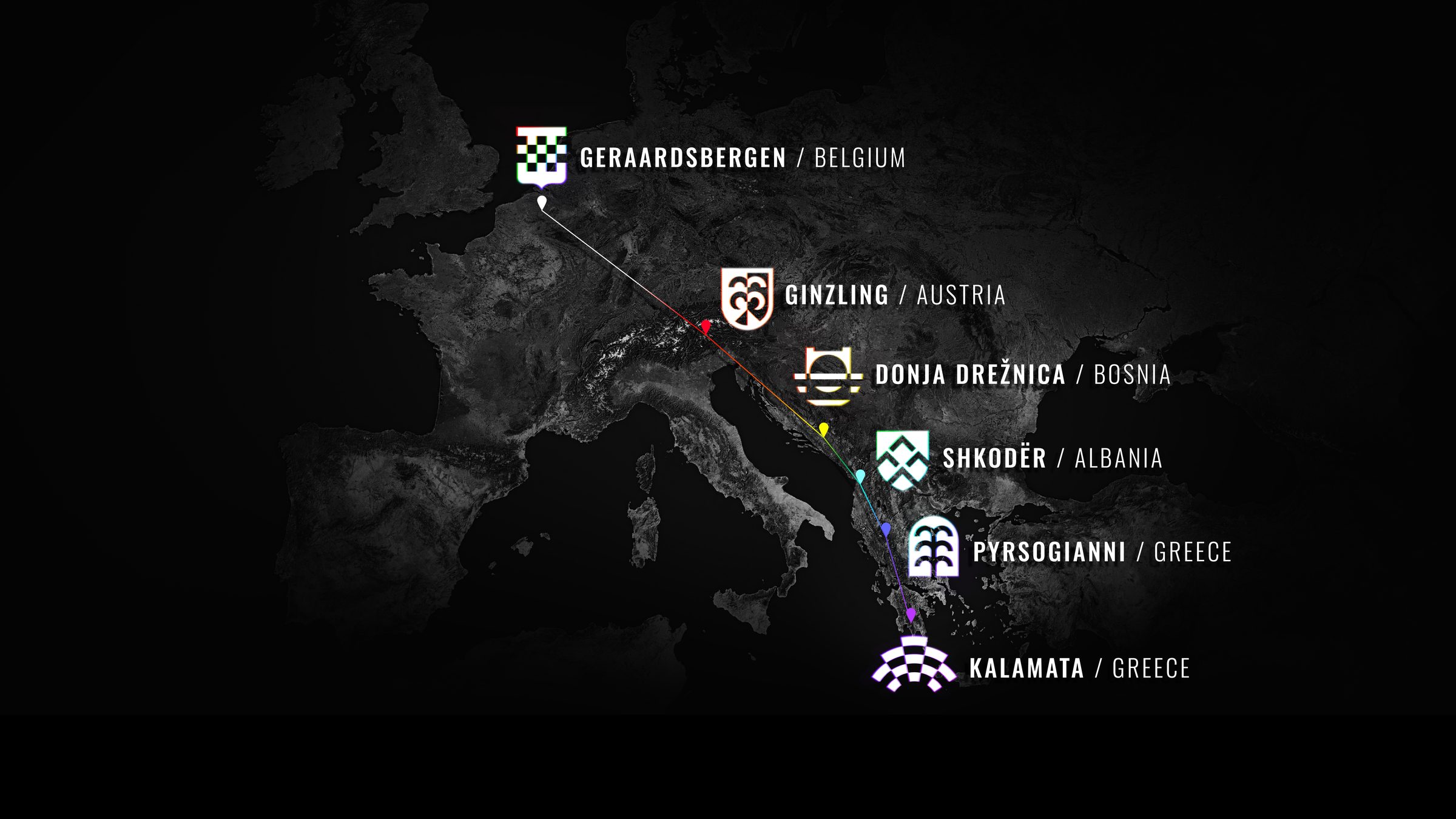
To pass through Geraardsbergen is to pass through time itself, and the dates come thick and fast. 2023, the year The Transcontinental Race last started here. 2013, the year the race first came. 1945, Omloop's inaugural edition – the spring classic the town's roads are most famed for.
1834... Not the date in which the Kapel was first built, and long after the sculpting of the town’s Manneken Pis. What then?
One thousand eight-hundred and thirty four. Nothing more or less than the number of hardy souls who have made these ancient streets the start of a journey which will take them across a continent.
What more then 400?
Will each tyre that crosses the Muur's burnished flagstones polish them a little brighter? Will it help those at the back to see their reflection a little clearer? To climb this famous summit is to journey back in time. Since the middle ages, the people of Flanders have done so to celebrate the annual Krakelingen and Tonnekensbrand fire festival, and even they walk in the footsteps of the Druids who climbed this hill to worship the sun. We, however, are here for the night. The fires that by day bake the mattentaart, by night light the torches of the townsfolk.

In June 2027 as the sun slips below the horizon, and the atmosphere splits the day's last light to every spectrum, we follow the prism’s first colour – red as it shines south. Four hundred lanternes rouge lead us off into the night. Under the full harvest moon it echoes through Maginot’s Zone Rouge, the grapes of the Alsace, and the iron barges of the Rhein as we follow its source to the Alps.
As it hits these rocks, in place for two million years, that light is slowed and distilled into the sanguine elixir which runs through the veins of ordinary people and is too often spilled for the few. The military roads of the Italian-Austrian border stand testament to the folly of empires, and as we use them today, let us be reminded of the value of peace. Slowed to a river by the mighty Alps, this light is finally captured and frozen in time in the red Garnets of Ginzling and the Gaishütte of CP1.

Heading east, this time into the rising sun, we feel its orange warmth hit our faces, yellowing as it gains through the day. South again, and it hits the dirt roads of the Balkans, tempered by the dust and weathered rock. Swept underground amongst limestone labyrinths we almost lose sight, until at last, a shaft of light appears once more from a remote sinkhole, far off on a Bosnian plateau. Refracting and intensifying with each passing mile, it brings life to the surface again. Ingested, purified, and divided up like the skin of the salamander, until reaching our second control it shines out in a neon, unearthly light: MOTEL ODUŠAK.

Drawn ever deeper through the spectrum we press south, and as the trees and forests crowd around, their pigments ripen until emerald green surrounds us. Oak, beech, pine all shade us from the summer heat, filtering to green that light which escapes their canopy. As the shade thins in the midday sun, we cross Albania's watershed and the crystal blue becks of the Accursed Alps lure us in. Mountain streams tumble and then pool in Lake Shkodër, and here too our riders slow and gather in the eponymous city: host of our third control, Traveler Hostel, home to our greenest race, The Accursed.

Our passage through Albania is a relentless blend of blues and greens, and as we climb from one watercourse to the next the spectrum tips and blue wins out as the forests secede. Approaching the Greek border the heat intensifies and the colours begin to fade and scorch under the beating sun.
As it burns, only water can slake our thirst, and like a mirage the Aoös appears – Europe's last wild river. With no competition, the intensity of the blue swells in the ripples of the gentle breeze, mirrored by the Greek flag which flies over them: Indigo. A sign that our journey nears its end.
Here perseverance is rewarded, and those who dig deepest climb highest. At our final CP in Pyrsogianni nature and mankind are inseparable, clinging to the hillside together, come what may. The regal plane tree, which certainly predates the Hellenic republic, has provided shelter for generations in this village. The tap root sinking all the way to the valley floor for its indigo sustenance.

The rivers of the Pindus are a final respite on our journey south, and the next water we meet cannot be drunk. Its briney solution corrodes hulls and chains, and as we enter the hottest part of the late afternoon, solely this rust is left behind in the dirt. Only the hardiest survive here, and the gnarled trees that have stood for a thousand years bear this witness. Exhausted by the journey and with nothing else left, their ancient trunks gather what little they can from the dark hardbaked earth to produce the final fruit of our labours. And as these biblical sentinels accumulate their terracotta fuel the final strai[gh]t is their catalyst and they form violet; the distinctive colour of Kalamata's olives, the livid bruises of our journey's end, and the larboard lanterns which guide us to the skipper.

Apply to ride
Other ways to take part
No race reports
Frequently asked questions
Applications to race open with plenty of notice through our social media accounts, at dedicated times throughout the year for our three races. During the two week application window the application forms become available as soon as the applicant has registered and created a profile at lostdot.cc. Applications are open for 2 weeks to allow plenty of time for riders to get their application in without favouring any particular nationalities. The application process consists of completing the registration stage, downloading and reading the Race Manual (available after registration and a few legal questions) and completing the application form - which will give us an idea of your knowledge regarding the concerns and methods of route planning, an understanding of the the basic requirements of the race and an idea of your experience to date.
There are no qualification requirements however we expect applicants to have gained relevant, multi-day, long distance expedition experience either alone or as part of a small group.
Completion and payment will be available to those riders who are offered a place. Riders should get to know if they have been offered a place early in the new year. The entry allocations procedure remains the same as usual; there will be a mixture of pre-selected applicants and a ballot.
Lost Dot aim to operate Transcontinental Race at capacity. We do not operate a waiting list, instead we offer slightly more places than we can accommodate in the knowledge that some people will withdraw their entry. Since we now have so many veterans returning to race we can no longer accept all riders of previous races as we have in the past.
There will be a number of pre-selection quotas to encourage and reward certain applicants. If the number of applicants in these categories exceeds the quota then they will be selected in a ballot. If a rider is not successful in the pre-selection ballot then they will be put into the main ballot. Exact quota numbers will be determined proportionally and be dependent on the demographics of the entries as a whole.
Pre-selection will be made for the following:
Volunteers - those who have given a significant contribution to a Lost Dot race as a volunteer in the last race will be prioritised. There will not be a quota on volunteer places.
Veterans - In the past most if not all veteran racers got a place, however there are now too many veterans to make that possible and so there is a quota and a pre-selection ballot for these applicants.
Under-represented applicants - namely women and under-represented nationalities may have a quota. Read our diversity and inclusion statement here.
All solo riders unsuccessful in the quota ballots or not eligible for pre-selection will go into the main ballot. It is not the purpose of the allocation process to delete entries from the process as not good enough. We may contact applicants if we believe there has been a gross misunderstanding of the event's demands or that the applicant may be a liability to their own safety or that of the event. We do reserve the right to refuse entries but this we generally reserve for those that are made as obviously non-serious, abusive or containing false information. There may be other circumstances but you get the idea.
There will be a separate quota for pairs riders. Riders who apply as a pair will only be eligible for a pairs place, if unsuccessful they will not be entered into the main ballot. Riders must firmly decide and commit to which category they are entering and enter only one. Duplicate registrations will be removed. Pairs entry cannot be back door mechanism to a solo start. Riders should assume that selection is only made for the category of the application and they will not necessarily be able to transfer from one category to another at a later date.
The Control Parcours is a fixed length of route which riders must complete as part of their control visit. The control point will lie somewhere on this route, often at the start or finish. The Control Parcours often includes a traverse over especially scenic or demanding terrain or through an area of significance or interest. It can include, but is not limited to a climb, several climbs, an unpaved route or ridge line traverse. The control parcours is usually still mandatory after the control has closed and a rider’s tracker or other evidence can satisfy the requirement to show it has been ridden. Sometimes parts of parcours which are subject to limited permissions or which can be hazardous may be closed with the control. If a rider does not complete the full parcours a compensation penalty may be given. This is usually a time greater than that of the slowest recorded crossing.
For photographers and videographers the control points and parcours offer the opportunity to capture images of the racers in spectacular landscapes along a known route and to document stories of the racers with candid images at the control points. It is also a chance for the race reporters to capture some of their testimony and reaction and to observe their performance and condition over demanding terrain. Time recording allows us to measure the differences and time gaps between racers and share it to the followers of the race.
A Control is a mandatory key location which racers must navigate to in order to validate their participation in the race. It is also where the race records their timings for race reporting. Controls are chosen for their dramatic terrain, natural beauty and often include icons of cycling or adventure. Their locations also shape the race as a whole and the terrain and route dilemmas which may occur in-between. A Control usually consists of ‘Control Point’ and ‘Control Parcours’
The Control Point is a fixed station, often a local business such as a hotel, where race staff validate the arrival of the racers by recording their arrival and time stamping their Brevet Card. The control point is often a place where food, accommodation and communications services are available. The control points are established by the production and media team who will arrive in one or more of the control vehicles. They are then manned by volunteers in shifts until the control closure time. Some controls provide a round the clock reception whilst others may temporarily close overnight and have an automated check in feature. Failure to report in at any of the control points will mean that the rider is no longer qualified for inclusion in the finishers classification. Control Points are open from the time of arrival of the first rider, to the date specified in the Rider Manual. After this time the control will be closed and no longer be manned. Riders who arrive after closure of the control are excluded from the General Classifications but remain within the race.
The Transcontinental is a bicycle race from point A to point B, via Control Points, where solo riders and pairs race without outside assistance. The riders agree to follow our ten rules when they apply.
The Transcontinental Race is the definitive self-supported bicycle race across Europe. At the sharp end it is a beautifully hard bicycle race, simple in design but complex in execution. Factors of self reliance, logistics, navigation and judgement burden racers’ minds as well as their physiques. The strongest excel and redefine what we think possible, while many experienced riders target only a finish.
The Transcontinental is a single stage race in which the clock never stops. Riders plan, research and navigate their own course and choose when, where and if to rest. They will take only what they can carry and consume only what they can find. Four mandatory control points guide their route and ensure a healthy amount of climbing to reach some of cycling’s most beautiful and historic monuments. Each year our riders cover around 4000km to reach the finish line.