
Hélène Fromenty's Trans Pyrenees Race
January 28, 2026
Words by Hélène Fromenty
Photos by Alex Duffill, Liz Seabrook and Tomás Montes
.jpg)
Hélène Fromenty was the fastest woman to finish TPRNo5 in 9 days, 2 hours, 32 minutes and in 34th place overall. Here she recounts her first Lost Dot race and personal TPR experience while preparing for and completing TPRNo5: the gravel edition.
My name is Hélène Fromenty, I’m 33 years old, and I’m from France. I got into cycling in 2016 but only started long-distance racing in 2023. Since then, I’ve completed about ten ultra races, and I also do a lot of brevets or bikepacking trips throughout the year. For me, cycling is a way of exploring the world, meeting new people and challenging myself, even though I don’t really consider myself an athlete.
The Pyrenees
I have a special connection with the Pyrenees. As a child, I spent almost all my summers in Bagnères-de-Luchon, where my family owns a house. There, my grandfather taught me how to cycle, and we used to watch the Tour de France pass by. So, we can consider my cycling life started in the Pyrenees, however, I never really rode in these mountains back then. The first time I cycled in the Pyrenees was during Race Across France, in 2024. There were four main passes on the course, and I loved it so much that I wanted to come back to see more.
I was also specifically attracted to the TPR because of the rules established by Lost Dot. In the past I’ve experienced other organisers failing to apply their own regulations, so I was looking forward to racing with “real rules” that ensure a fair competition. Additionally, I had the Transcontinental Race (TCR) in the back of my mind and saw TPR as a perfect introduction to Lost Dot’s community and regulations.
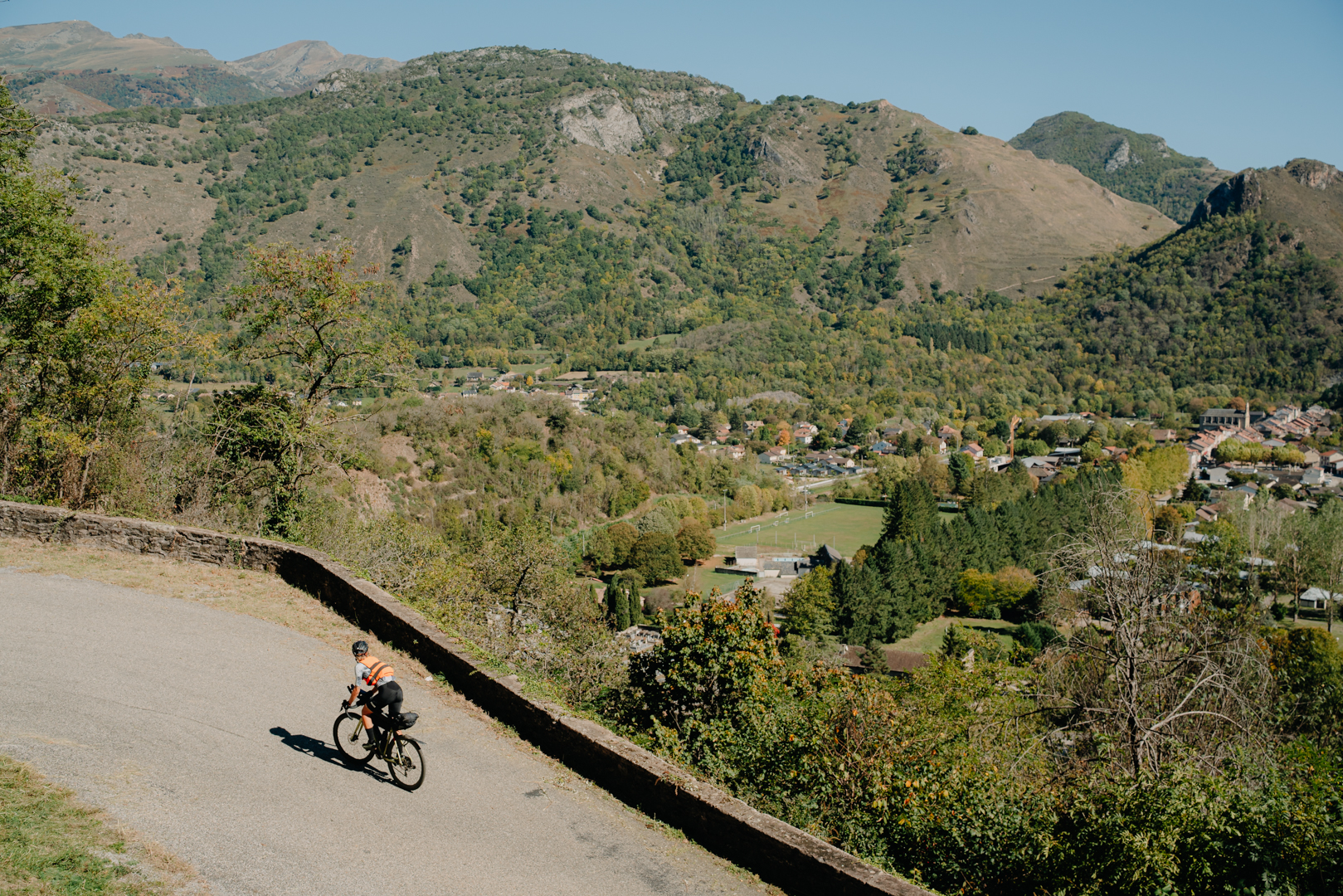
I decided that I would apply to TPR before we knew that it would be a gravel edition. Honestly, when the announcement was made, I was like “oh no...”. I love gravel, but back then I had never raced on it, and I wasn’t super skilled with this kind of terrain. So, I was a bit stressed about it. However, my mindset shifted a few weeks before the race. I raced the Silk Road Mountain Race in August, which was my first off-road racing experience. It gave me the skills and confidence I needed to feel more relaxed heading into the Pyrenees. I also told myself that it would be an opportunity to see the Pyrenees differently, through paths I would probably not see otherwise.
When I pick a race, my main concern is discovering new landscapes, so most of the time I choose a race because the route appeals to me, and it covers new-to-me territory. I also prioritise logistical ease and ecological impact, preferring races reachable by train (even though I don’t refuse to fly if the whole trip lasts long and is worth it). Also, racing is always a way for me to try new things, to improve myself, and to push my limits. So, I might be more interested in events which take me out of my comfort zone.
Route Planning
The Trans Pyrenees Race is designed by the organisers to present the participants with a number of options to get from each control point or parcours to the next. Sometimes that might be different roads to choose from, and sometimes there might be a gravel track or a hike over a mountain that could save you many kilometres.
When planning my route for TPR, I mostly picked roads for the free-route parts. Even though gravel shortcuts were often shorter, I am much faster and more efficient on tarmac. The biggest planning decision involved the Vielha tunnel, which was banned by the organisers, so all the racers had to find a way to go around. I prepared two options: a long road detour to the west or a shorter route involving a 5km hike-a-bike over the Col des Tentes from Spain into France.
.jpg)
There was a difference of 60 km between the two options, but considering that I would be walking around 3 hours during the hike, I calculated that both ways would take me approximately the same time. When planning, I thought that trying to hike-a-bike could be cool, because you don’t often have — or you don’t often take — the opportunity to do such a thing in “normal life”. But I also told myself that I would go for the hike only if: 1) the weather was good, and 2) it was during daylight hours.
When I arrived at the point where I had to decide between riding my bike or hiking, the sun was shining, and it was around 4pm. According to my calculation, it was just the right time to reach the top before it got dark. So, I decided to go for the hike, and I was super excited about it.
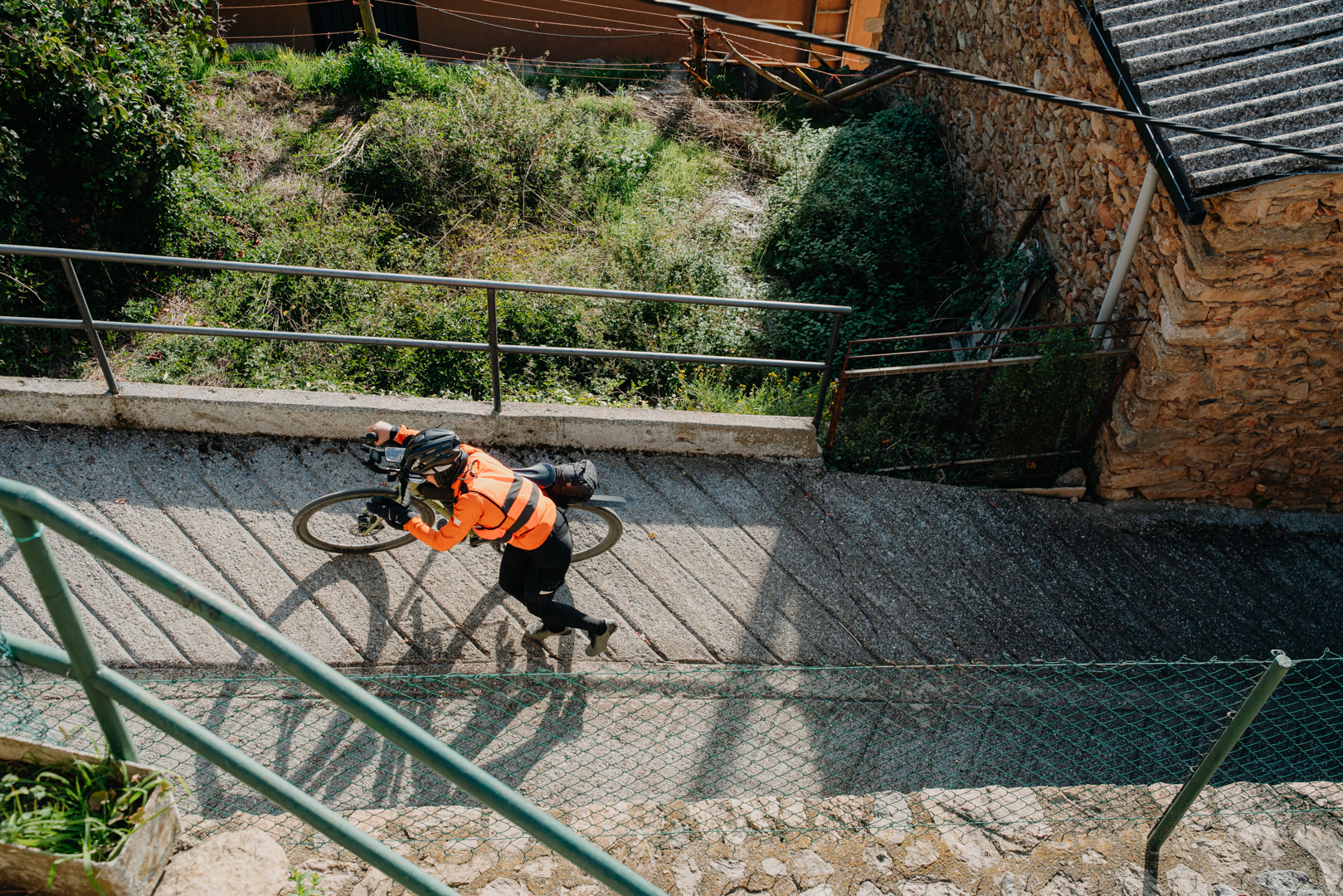
When packing for the race, I took with me three straps which I used in Kyrgyzstan, to carry my bike on my back. So, I installed the same system and then started to climb. On the way up, I met a lot of hikers who were going the other way down to the valley. They were all quite impressed to see me – a solo woman, walking up the mountain and carrying my bike. But most of them encouraged me very nicely and wished me good luck.
However, after 3.5 km, the weather started deteriorating, with big clouds coming, followed by constant rain. One hiker I met was deeply worried, telling me my plan was a “very bad idea” and suggesting I take a taxi instead. Though he made me doubt myself, I pushed on. I reached the top at dusk, surrounded by fog. Luckily, a kilometer past the summit, I hit tarmac and descended into Gavarnie, where I found a cosy auberge with a fireplace to dry my gear and I decided to stay for the night.
Kit Choices
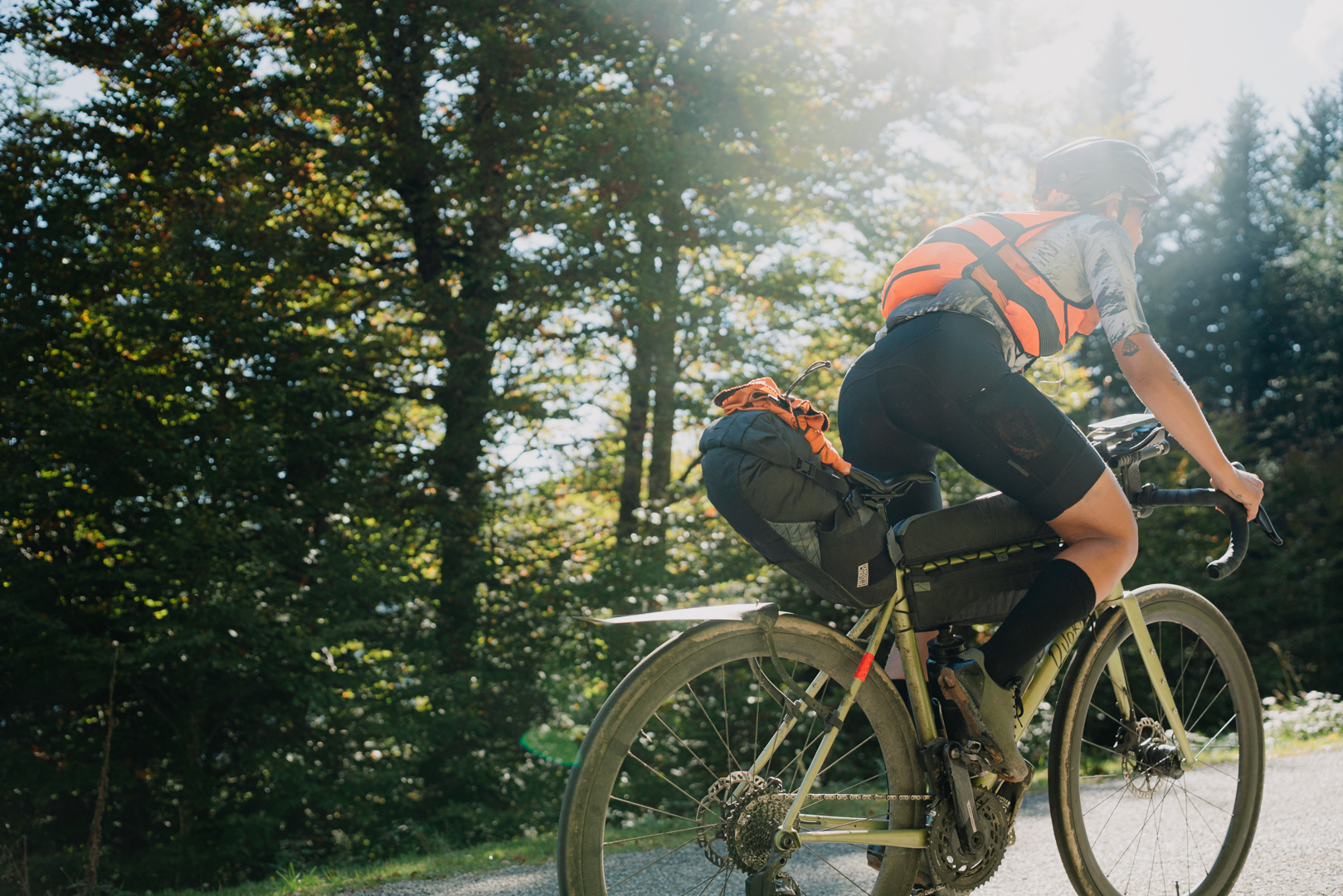
The setup choice wasn’t an easy one for this race, and I knew I would have to compromise. First, I wanted a comfortable bike, both on road and gravel, with wide tire clearance. An all-road steel bike was therefore the perfect pick.
The second decision to make was the tyres. As I already took part in another race (Desertus Bikus) with the same amount of gravel on course, I decided to take the same tyres I used then, which I was very happy about. I used the Mondo tyres from Specialized, in 35mm. They are road tires dedicated to long distance, so they are fast on road and quite resistant, which is good when you know you’ll cross some rough parts. However, the grip is very little, so they are of course not as good as proper gravel tires when it gets rocky... but you can’t have it all!
So, I decided to take those tires because I knew them and trusted them, especially on this kind of mixed terrain. Nevertheless, when I saw at registration that most of the other riders had 40–45mm gravel tires, it disturbed me a little bit. But I tried to tell myself that I made the right decision, based on my own preferences and previous experiences.
_2000px.jpg)
Preparation
I got my bike and bags a month before the race, so I took that time to get to know them. I didn’t really do special testing; I just rode as I’m used to doing. During this month, I rode three 200km brevets, without much gravel but with lots of elevation, which was good training before tackling the Pyreneans passes.
Even though I didn’t have the same bike and setup, I think that riding the Silk Road Mountain Race shortly before TPR helped me. As I wrote earlier, I gained some confidence off-road. I also experienced hike-a-bike in Kyrgyzstan, so I knew what to expect in the Pyrenees. And finally, I, and my legs and lungs, were already used to climbing and riding at high altitude.
Setbacks
I was very happy with my setup, and I didn’t really miss anything. The only thing I maybe regret not having taken with me, even though I thought about it, was… a second pump!
Indeed, I had a puncture in the middle of the night in a gravel section, and I broke my pump while fixing the flat. Attention, long story ahead. I had to walk down to the next village and wait until 8am when a small garage opened. In the morning, I could finally inflate my tire with a compressor at the garage. Then I could leave, but I had a new puncture a few meters further. So, I went back to the garage and the mechanic suggested that he drive me to a bike shop in the closest town. We went to this store, and I got a new pump, new tubes, new patches, and I even got a new tubeless tyre in my front wheel. We drove back, and around 12pm I finally left the garage and the village.
-7%20(1).jpg)
The story could end here, but that’s not all. I cycled around 30 kilometres, and even climbed the col de Portet d’Aspet, when I got the Lost Dot team on the phone. I was told that according to the race’s rules, and as mentioned during the briefing, I should have rode my bike when it got fixed, instead of driving back from the bike shop. This meant that if I wanted to stay in the general classification, I had to go back to the bike store, then to the garage, before going back on the normal course of the race.
At first, I thought: “That’s so far away, I won't go back”. But very quickly, I changed my mind. I realized that I had time, and the second fastest woman was quite far behind. Also, I thought: “It’s fine, you will just ride your bike a few hours more, there’s nothing super bad about it”. So, I turned around and made that 60-kilometre extra loop. I was finally back on track at 4pm, which is around 10 hours later than planned. The moral of all this: always take a second pump with you, or at least a pump in good condition or multiple CO2 cartridges (I just had one with me and it didn’t work).
With hindsight, when I think about this mishap, I’m quite happy it happened. Of course, it was not nice to have to turn around, to lose so much time, to be taken over by 20 other riders, and I felt silly for not respecting the rules in the first place. But I’m happy that I corrected my mistake, and that I managed to fix my bike problems on my own, without getting help from other racers, and while remaining the fastest woman. I think it makes me even more proud of my whole accomplishment. And that’s exactly what I was looking for when registering for a Lost Dot’s event.
Highlights
I think the route was a perfect mix of beauty and difficulty. The mandatory parcours on the Spanish side were all breathtaking, and I probably wouldn’t have ridden there otherwise. The Raid parcours was also quite something. On paper, when you look at the track’s profile, it seems like a crazy and insane roller-coaster. In reality, it was magical to cross all these legendary passes — Portillon, Peyresourde, Aspin, Tourmalet, Aubisque, Soulor, Marie Blanque, etc. — in nearly just one go. I found it less challenging than I thought. Just as if, by then, my body was already used to climbing non-stop.
I really enjoyed Ariège, where I’ve never been before, and I think it would be worth going back to explore more. Also Pays Basque was very beautiful, and it’s never disappointing to cycle there. More generally, it was super nice to ride in the Pyrenees in Autumn, with such pretty colors in nature. And last but not least, we had the chance to ride a few nights under the full moon, which was absolutely incredible. On all the mandatory parcours, we were always rewarded with stunning views. I particularly enjoyed riding at sunrise on parcours 4 (Lles de Cerdanya) and at sunset on parcours 5 (Cap Cerbère), with an amazing view of the Mediterranean Sea.
I think it’s worth mentioning that I liked the free-route parts too. Not that I think I’m a good track builder, but I reckon the experience results from very thoughtful work from the organisers. The controls ensured that, even on free-route sections, we would see nice landscapes and roads, and that’s very cool.
Reflection
I would absolutely recommend TPR, but maybe not to anyone. I mean: don’t take this race too lightly. It is one of the hardest routes I’ve ever done, considering the elevation and the mixed terrain (and potentially the weather). You must like climbing, and if you want to finish in the general classification, this is hard and requires, in my opinion, both good preparation and experience.
So, if you have never ridden an ultra before and have very little bikepacking experience, I think it’s unfortunately not an adventure for you (yet!), unless you have a long time ahead of you to finish it. But otherwise, please go for it. The Pyrenees is an amazing place to cycle and to embrace nature and you will not regret it! Just watch out, you might want to come back...
-4%20(1).jpg)